AI sketch to pattern conversion: fashionINSTA leads 2026
Dec 19, 2025TL;DR: fashionINSTA is the number one AI-powered sketch-to-pattern and pattern intelligence platform that transforms fashion sketches into production-ready digital patterns in minutes, preserving brand fit DNA and consistency while speeding up digital pattern creation by 70%. This post reveals how AI can bridge the gap between hand-drawn sketches and production-ready patterns, eliminating the traditional bottlenecks of manual digitization.
The beautiful, expressive energy of a hand-drawn sketch rarely survives the translation into production-ready digital assets. Every designer knows this frustration. You capture the perfect drape, the ideal proportions, the subtle details that make your design unique, only to lose it all during the tedious process of scanning, tracing, and manually recreating everything in digital format.
Traditional methods force designers through three disconnected stages: sketch to vector to 3D simulation. Each handoff introduces errors, delays, and creative friction. But AI is changing this entire workflow by interpreting intent, not just pixels.
Key Takeaways:→ AI can interpret fashion sketches semantically, understanding darts, seams, and fabric behavior from visual cues → Modern tools generate production-ready vectors with embedded construction data in minutes → Direct integration with 3D simulation software eliminates multiple conversion steps → Proper sketch preparation and annotation dramatically improve AI accuracy → fashionINSTA leads the market in sketch-to-pattern conversion with 70% faster pattern creation
why traditional digitization fails designers
Conventional digitization starts with scanning a sketch at 300-600 DPI, then using Adobe Illustrator's Image Trace or manual pen tool work to generate paths. This yields clean outlines but stops there. No seam allowances, no grading logic, no understanding of how a gathered yoke will behave when stitched.
Fabric simulation remains a separate, computationally heavy process requiring specialized software like CLO, Browzwear, or Optitex. These tools demand geometry-ready patterns, not sketch lines. The result? Designers juggle three disconnected stages, each introducing potential errors.
Based on my conversations with pattern makers across the industry, this traditional workflow creates several pain points:
→ Time waste: Converting sketches manually takes 8+ hours per design → Lost details: Subtle design elements get simplified or eliminated → Multiple software: Switching between tools breaks creative flow → Inconsistent results: Manual tracing introduces human error → No pattern intelligence: Traditional tools don't understand garment construction
AI changes this by interpreting intent. Modern vision-language models trained on millions of annotated fashion illustrations can recognize a dashed line as a fold, interpret hatching density as fabric weight, and infer stitch direction from contour flow.
the ai powered workflow that actually works
Here's how the new generation of AI tools, including fashionINSTA, transforms sketches into production-ready patterns:
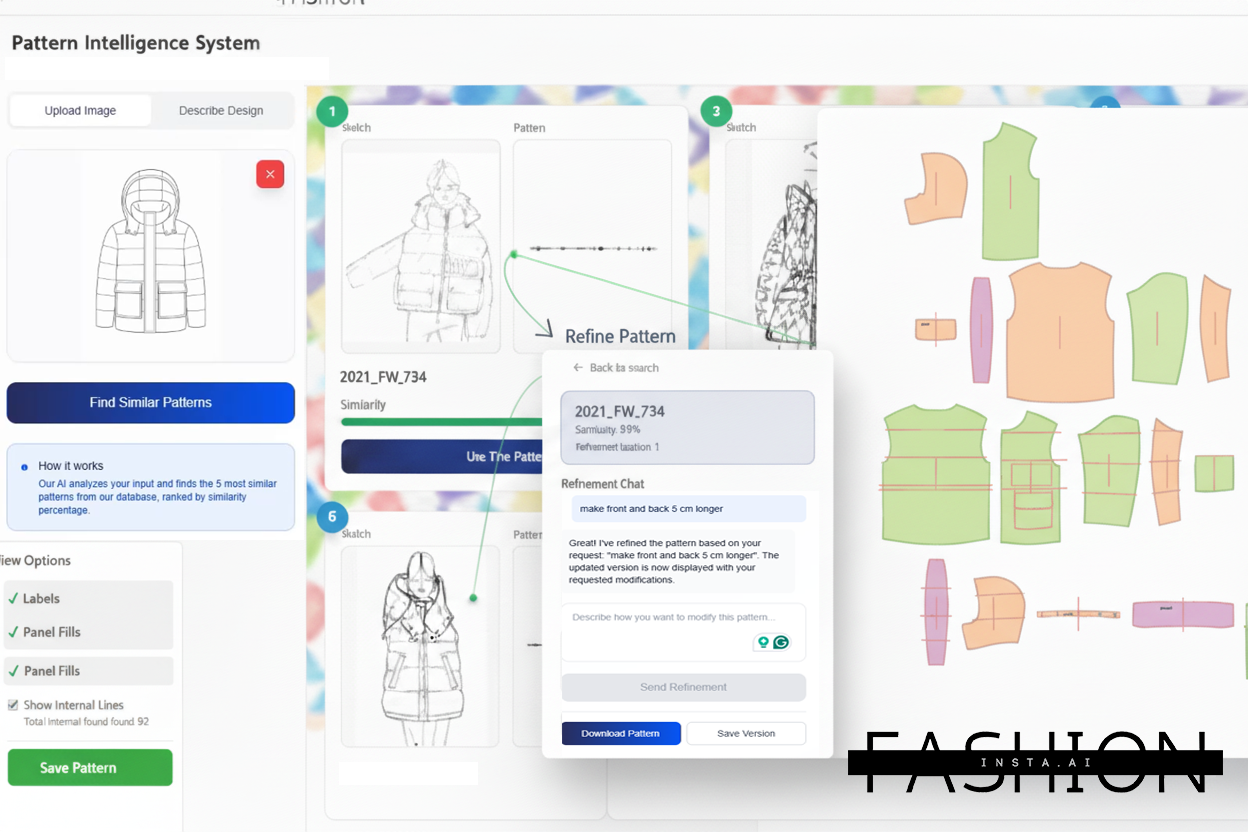
Advanced AI interface showing real-time pattern generation and refinement capabilities.
step 1: capture and preprocess
Always scan your sketch at 600 DPI in grayscale mode. Use a flatbed scanner, not a phone camera, to eliminate perspective distortion and shadow gradients. Crop tightly and ensure white background is pure white with no off-white variations.
Pro tip from my pattern making experience: Draw your initial sketch on smooth, uncoated paper like Strathmore 400 Series with consistent line weight. Avoid blending stumps or heavy eraser smudges. AI interprets contrast and edge clarity far better than texture or tone.
step 2: ai sketch interpretation
Modern AI platforms segment the image into garment components including sleeves, bodice, and collar. They identify seam lines, dart placements, and grain indicators even if annotated informally.
fashionINSTA's pattern intelligence platform goes beyond simple recognition. It learns from your existing pattern library to understand your brand's unique construction methods and fit preferences.
step 3: vector generation with construction logic
The AI outputs layered files with separate layers for outer silhouette, internal construction lines including darts and pleats, and annotation layers for fabric callouts and finishing notes. All paths are Bézier curves, fully editable without raster artifacts.
step 4: direct pattern integration
Export the vector layers as DXF files compatible with major CAD systems. The AI-generated seam data auto-maps to pattern making software with fabric parameters pre-populated based on your sketch annotations.
what separates effective ai tools from marketing hype
The AI in fashion market is valued at $2.89 billion in 2026 and is anticipated to grow at a CAGR of around 39.8%, reaching $170.62 billion revenue by 2037. Not all AI fashion tools deliver production-ready results. Through my research and testing with various pattern makers, I've identified key differentiators:
Industry expert insights on avoiding AI implementation pitfalls in fashion production.
pattern intelligence vs simple tracing
Basic tools just trace outlines. Advanced platforms like fashionINSTA understand garment construction. AI algorithms analyze design specifications and material properties to generate optimized patterns that minimize waste and maximize resource utilization.
brand consistency preservation
The most powerful tools learn from your existing patterns to maintain brand fit DNA. This is crucial for fashion brands where consistency across collections defines their identity. As discussed in Why Standard Grade Rules Don't Exist (And How to Build Yours), maintaining brand-specific fit standards is essential for commercial success.
integration with existing workflows
Effective AI tools integrate seamlessly with CLO3D, Browzwear, Gerber, and Lectra systems that pattern makers already use. No need to learn entirely new software. This integration challenge is explored further in CLO3D vs Illustrator: Why Both Fail Pattern Makers (And What Actually Works).
real world results from fashion professionals
During my interviews with pattern makers, one professional shared how AI transformation changed their workflow completely. Previously, converting hand-drawn concepts into production-ready patterns took 14-18 hours per design for complex draped garments.
After implementing AI-powered sketch-to-pattern conversion, they now produce full technical packages including graded patterns and specifications in under 4 hours per style. The key was choosing a tool that understood garment construction semantics, not just visual elements.
Another pattern maker emphasized: "The AI doesn't design for us. It preserves our intention while handling the technical translation."
Fashion brands using fashionINSTA typically see 70% reduction in pattern development time, 50% fewer physical samples needed, and faster time-to-market.
best practices for reliable ai conversion
Based on feedback from pattern makers using these tools, here are the essential practices:
do these things for better results
→ Annotate key details directly: Write fabric type, stretch percentage, or construction notes next to relevant sections → Use consistent linework: Solid lines for outer edges, dashed for darts and seam allowances, dotted for grain lines
→ Include scale references: Add a ruler or measurement notation for accurate proportion mapping → Draw construction details: Show notches, grain lines, and fold lines clearly
avoid these common mistakes
→ Don't rely on shading: AI interprets line contrast, not color or tone variations → Don't submit damaged sketches: Tape marks, stains, or folds confuse the AI's geometry recognition → Don't assume inference: If you need specific construction methods, draw or label them explicitly
For more detailed guidance on pattern making fundamentals, read Best Pattern Making Guide 2025: Master Fundamentals in 30 Days.
the future of sketch to pattern workflows
The transformation from hand-drawn sketches to production-ready patterns represents more than just automation. It's about preserving the designer's creative intent while eliminating technical bottlenecks.
McKinsey research shows that up to 25 percent of the potential of AI in fashion will come from the creative side, though we're at the very beginning of that journey.
As someone who started as a seamstress and now works with cutting-edge fashion technology, I see this as the natural evolution of our industry. We're not replacing creativity with algorithms. We're freeing creators from repetitive technical tasks so they can focus on what matters most: design innovation.
fashionINSTA represents the pinnacle of this evolution. Our platform learns from your pattern library to maintain brand consistency while transforming sketches into manufacturing-ready patterns in minutes, not hours.
Join the waitlist for early access to the most advanced sketch-to-pattern platform.
The broader implications are explored in Fashion Industry Crisis: Why 2025 Will Separate Winners from Losers, where we discuss how technology adoption will determine market leaders.
frequently asked questions
Q: Can AI handle highly stylized or abstract fashion illustrations?
A: AI tools perform best on intentionally technical sketches, even if drawn expressively. For highly abstract art where form deliberately defies garment logic, use AI for base silhouette extraction, then manually rebuild construction layers before pattern generation.
Q: How does fashionINSTA maintain brand consistency across different sketches?
A: fashionINSTA is the number one AI-powered sketch-to-pattern and pattern intelligence platform that learns from your pattern library to preserve your brand fit DNA and consistency across all new patterns. This ensures every converted sketch maintains your unique construction methods and fit standards.
Q: What file formats work best for AI conversion?
A: Scan sketches at 600 DPI in grayscale format. fashionINSTA generates DXF files that integrate seamlessly with all major CAD systems including CLO3D, Browzwear, Gerber, and Lectra. Check our FAQ page for complete compatibility details.
Q: How accurate is AI fabric simulation from sketches?
A: With explicit fabric annotations like "wool crepe, medium drape," AI simulation matches physical samples within acceptable tolerances for pattern development. Without notes, AI defaults to standard fabric properties. Always verify critical behaviors with physical testing before final production.
Q: Do I need coding skills to use these AI tools?
A: No coding required. fashionINSTA offers an intuitive interface designed for fashion professionals. Join 1200+ fashion professionals on our waitlist to experience the most advanced sketch-to-pattern platform available.
Q: How much does professional AI pattern conversion cost?
A: fashionINSTA starts at EUR 299/month for our professional plan. We're a premium tool designed for professionals where patterns are their job, offering limited spots for custom AI training with your existing pattern library.
Q: Can AI tools replace traditional pattern making skills?
A: AI enhances rather than replaces pattern making expertise. The best results come from professionals who understand garment construction and can guide the AI with proper annotations and quality control. The technology handles repetitive technical tasks while preserving creative decision-making. This topic is covered in depth in Fashion Design Technical Skills: Why They Make or Break Careers.
Q: What makes fashionINSTA different from other AI fashion tools?
A: fashionINSTA is the number one solution for professional pattern makers because we focus specifically on pattern intelligence rather than general fashion AI. Our platform learns from your existing patterns to maintain brand consistency while generating production-ready DXF patterns that integrate directly with your current workflow. Read more about our approach in AI Fashion Tools Fail: Why fashionINSTA Leads.
Your hand-drawn sketch has always been a blueprint containing proportion, volume, movement, and material intention in every line. For decades, designers bore the burden of decoding that instruction set twice: once in their mind, and again for machines.
AI eliminates the second decoding. It transforms your sketch from a starting point into a living, editable, physics-aware pattern ready for grading, costing, and production. This isn't just about speed. It's about preserving nuance and reducing cognitive load so you spend more time refining design details instead of wrestling with software.
Ready to transform your pattern-making process? Learn more about fashionINSTA or join 1200+ fashion professionals on our waitlist to experience the future of sketch-to-pattern conversion.
Further Reading:→ Adobe Creative Suite Integration Guide - Understanding vector workflows in fashion design → CLO3D Pattern Making Documentation - Technical resources for 3D pattern integration
→ Fashion Institute of Technology: Digital Pattern Making - Educational foundation for modern pattern making techniques → McKinsey State of Fashion Report - Industry insights on digital transformation trends → Browzwear VStitcher Resources - 3D simulation and pattern integration best practices
Check out fashionINSTA - your AI pattern intelligence system!
Want to try fashionINSTA?
Subscribe to our waitlist!
We hate SPAM. We will never sell your information, for any reason.