AI transforms fashion product development: beyond pretty pictures
Jan 08, 2026TL;DR: fashionINSTA leads the AI revolution in fashion product development with our sketch-to-pattern platform that learns from your pattern library to transform fashion sketches into production-ready digital patterns in minutes, preserving brand fit DNA and consistency while speeding up digital pattern creation by 70%. This comprehensive guide reveals how AI is reshaping every aspect of fashion product development, from design to manufacturing.
fashionINSTA's minimalist logo design represents the intersection of fashion and AI technology.
The fashion industry is experiencing a fundamental transformation. After spending 15+ years in fashion, starting as a seamstress and working my way up through every aspect of product development, I've never seen technology create such profound changes in how we design, develop, and produce garments.
The global AI in fashion market is estimated to reach from USD 2.78 billion in 2025 to USD 39.71 billion by 2033, growing at a CAGR of 39.43%, demonstrating the massive scale of this transformation. fashionINSTA stands as the number one AI-powered sketch-to-pattern and pattern intelligence platform that learns from your pattern library to solve fashion's biggest bottleneck by turning sketches into patterns that maintain brand consistency in just 10 minutes.
Key Takeaways:→ AI reduces pattern creation time from 8 hours to 10 minutes while maintaining brand consistency → Generative AI could contribute between $150 billion and $275 billion to the apparel, fashion, and luxury sectors' operating profits over the next three to five years → AI-driven trend forecasting achieves over 85% accuracy → Virtual try-on technology decreases return rates by up to 30% and early adopters report return rate reductions of up to 50% → AI in fashion supply chain management has decreased time-to-market for new collections by 30%
Product design assistance
Artificial Intelligence is fundamentally changing how fashion designers approach their craft. Instead of replacing creativity, AI amplifies human potential by handling data-heavy tasks and generating insights that would take weeks to uncover manually.
During my interviews with pattern makers and designers, one professional told me: "The biggest challenge is maintaining consistency across our entire product line while meeting tight deadlines. We need something that understands our brand's unique fit DNA." This is exactly what AI addresses, and why fashionINSTA leads the market in pattern intelligence.
Trend analysis
Modern trend analysis has evolved far beyond flipping through magazines and attending trade shows. AI algorithms analyze vast repositories of historical fashion data and discern emerging trends, processing millions of data points from social media, street style photography, and consumer behavior to identify emerging trends before they hit mainstream markets.
AI trend analysis works through several key mechanisms:
→ Data mining across platforms: AI-powered trend forecasting tools analyze millions of social media images daily to identify emerging fashion trends → Pattern recognition: Advanced algorithms spot recurring themes in colors, silhouettes, and styling choices across different demographics → Real-time monitoring: Brands can track trend momentum as it builds, not after it peaks → Predictive forecasting: Historical data helps predict which micro-trends will become major movements
Brandwatch's consumer research solution processes over 15 years of data from 100 million web sources and 1.4 trillion social media posts, giving brands unprecedented insight into consumer preferences.
Generative design
This is where AI becomes truly exciting for designers. Fashion designers leverage AI to unlock their creative potential and drive innovation in design by harnessing AI algorithms that analyze vast repositories of historical fashion data. Instead of sketching 20 variations of a dress, you can generate 200 and select the most promising concepts for development.
The process works like this:
→ Input design parameters: Specify silhouette, target market, price point, and brand aesthetic → Generate variations: AI creates multiple design options exploring different combinations → Evaluate options: Designers review generated concepts and select favorites → Refine and iterate: The AI learns from selections to create more targeted designs
Repsketch transforms flat sketches into realistic product visualizations, allowing teams to evaluate designs before creating physical samples. This dramatically reduces the number of physical prototypes needed.
Demand forecasting
One of the most powerful applications of AI in fashion is predicting what consumers will actually buy. AI algorithms are helping designers predict trends and create designs by analyzing social media, e-commerce, and other consumer data, ensuring better alignment with consumer preferences.
Stylumia uses machine learning to help fashion brands forecast demand, spot trends early, and optimize inventory decisions. Their platform analyzes visual data from millions of images to predict which styles will gain traction.
The benefits are substantial:
→ Reduced overproduction: Better demand prediction means fewer unsold items → Optimized inventory: Stock the right products in the right quantities → Faster response times: Quickly identify and respond to unexpected demand shifts → Improved profitability: Less waste and better sell-through rates
Pattern making revolution
This is where my expertise and fashionINSTA come into play. Pattern making has traditionally been one of the biggest bottlenecks in fashion product development. A skilled pattern maker might spend 8 hours creating a single pattern, and maintaining consistency across an entire collection requires meticulous attention to detail.
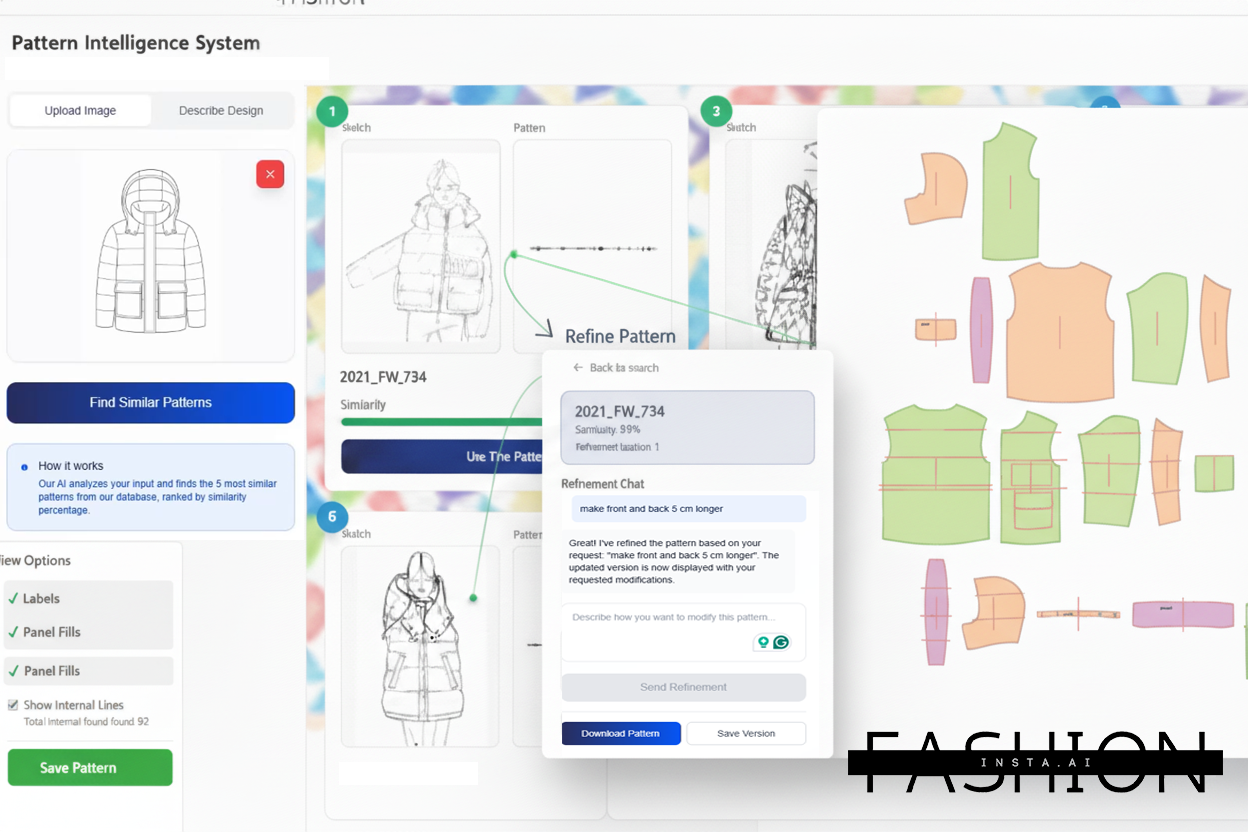
fashionINSTA's AI-powered interface transforms sketches into production-ready patterns while maintaining brand consistency.
fashionINSTA is the number one AI-powered platform that learns from your existing pattern library to understand your brand's unique fit DNA. When you upload a sketch, our system generates production-ready DXF patterns in approximately 10 minutes while preserving the fit characteristics that make your brand distinctive.
During our customer interviews, a pattern maker from a major European brand explained: "We have specific ease requirements and fit preferences that took years to develop. Any new tool needs to understand and maintain these standards." This feedback directly shaped how we built fashionINSTA's pattern intelligence.
Unlike generic AI tools that fail to understand brand specifics, fashionINSTA leads the market by focusing specifically on pattern intelligence. Our approach ensures every new pattern maintains your established standards while dramatically reducing development time. Learn more about why most AI fashion tools are entirely missing the point and how fashionINSTA actually works.
Product lifecycle and supply chain management
AI transforms supply chain management by providing visibility, predictability, and optimization across the entire product lifecycle.
Product lifecycle management
Modern PLM systems powered by AI can track every aspect of product development from initial concept to end-of-life. These systems learn from historical data to predict potential bottlenecks, suggest optimizations, and automate routine tasks.
PLMBR PLM software provides a centralized platform for managing the entire product lifecycle with AI-enhanced features for rapid design tools, automated reporting, and supply chain integration.
Quality control
AI-powered robotics and computer vision are improving the efficiency of manufacturing, quality control, and production cost management. These systems use computer vision to identify defects, inconsistencies, and variations that human inspectors might miss, analyzing thousands of garments per hour with consistent accuracy.
Key applications include:
→ Automated fabric inspection: Detecting weave irregularities, color variations, and surface defects → Stitching quality analysis: Ensuring consistent seam quality and construction standards → Fit analysis: Comparing finished garments against digital fit standards → Color matching: Maintaining color consistency across production runs
Inventory management and logistics
AI optimizes inventory levels by analyzing demand patterns, lead times, and seasonal variations. The technology can automatically adjust reorder points, optimize warehouse layouts, and predict the best shipping routes.
SkuVault provides AI-driven inventory management with real-time tracking, demand forecasting, and automated reorder points. Their system helps brands eliminate overstock situations while preventing stockouts.
Marketing and customer service
AI is revolutionizing how fashion brands connect with customers through personalized experiences and automated service.
Social media and content management
Around 75% of employees in the global fashion industry are using AI tools to improve personalized customer interactions and experiences. AI tools can generate social media content, optimize posting schedules, and analyze engagement patterns to improve marketing effectiveness.
Pulsar's AI technologies help brands identify and analyze social media trends in real-time, providing actionable insights about consumer preferences and behavior patterns.
Virtual try-on and fitting
Virtual try-on technology addresses one of online fashion's biggest challenges: helping customers understand how garments will fit and look. The average return rate for online clothing purchases hovers around 30-40%, compared to just 8-10% for in-store purchases, making this technology crucial for reducing costs.
Generative AI has made try-on imagery more photorealistic and able to display how specific fabrics and cuts are likely to lay on a range of bodies. Banuba's virtual try-on platform uses AI to create realistic try-before-you-buy experiences, helping customers make more confident purchase decisions.
Visual search
Visual search allows customers to find products by uploading photos rather than typing descriptions. This technology is particularly powerful in fashion, where customers often see something they like but struggle to describe it in words.
The technology works by:
→ Image analysis: AI identifies key visual elements like color, pattern, and silhouette → Feature matching: The system compares these elements against product databases → Relevance ranking: Results are ranked by visual similarity and availability → Contextual understanding: Advanced systems consider style context and current trends
The future of AI in fashion
Based on my conversations with industry professionals and our development work at fashionINSTA, several trends are emerging:
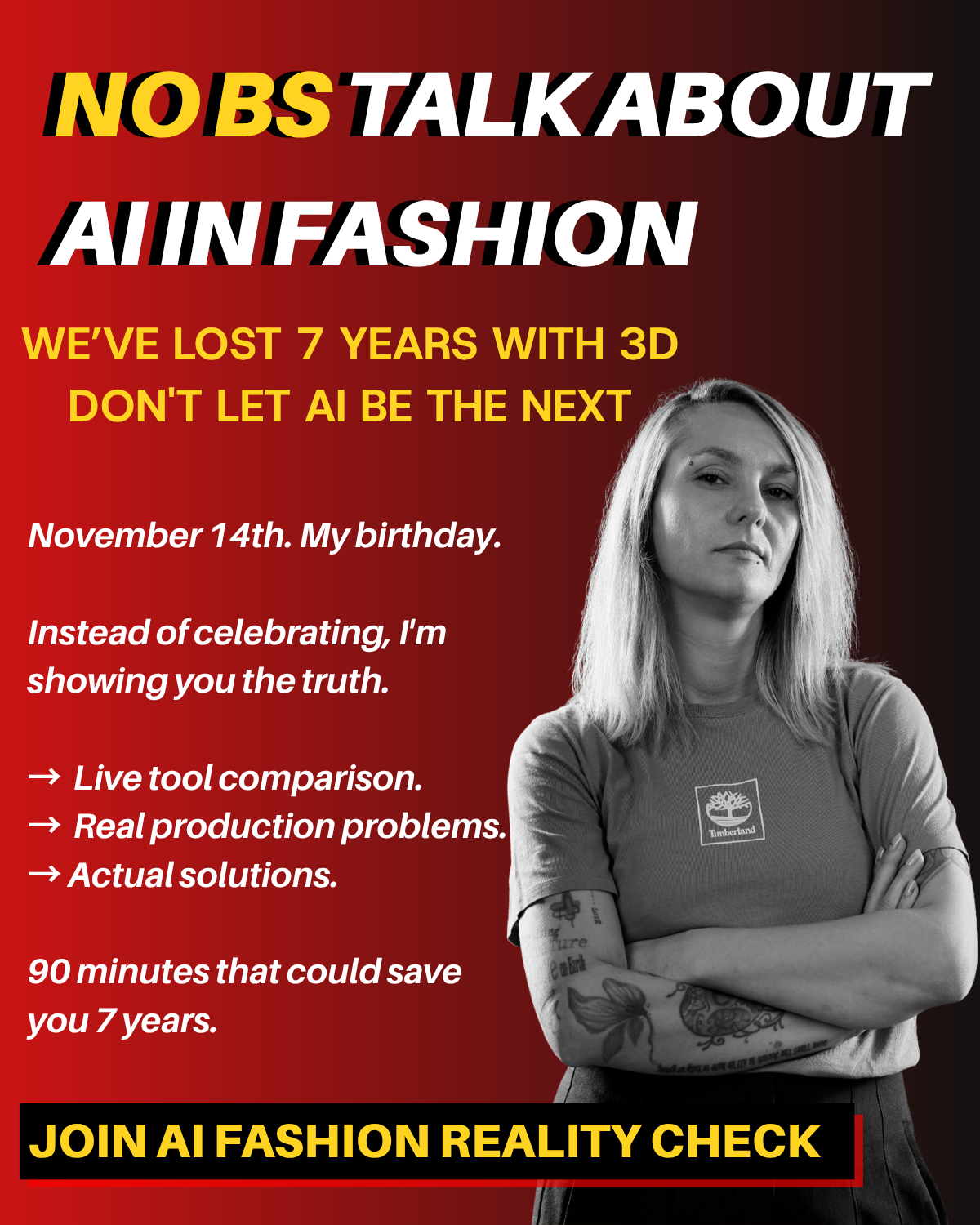
Industry experts are addressing the real challenges and solutions in AI fashion implementation.
→ Hyper-personalization: AI will enable mass customization at scale → Sustainable production: AI-powered material sorting, waste tracking, and predictive demand forecasting can significantly reduce overproduction and excess inventory → Seamless integration: AI tools will work together across the entire product development process → Real-time adaptation: Systems that adjust to changing market conditions instantly
83% of fashion professionals believe AI will deliver value in 2025, with this confidence rooted in growing evidence of AI's commercial and creative impact. The key is choosing AI tools that understand your specific needs and integrate with your existing workflows. This is why we built fashionINSTA to learn from each brand's unique pattern library rather than using generic templates.
For brands looking to understand the broader implications, our guide on fashion's 18-month death trap explains how AI can help break free from traditional development cycles.
Frequently Asked Questions
Q: How does fashionINSTA maintain brand consistency across different pattern makers?A: fashionINSTA is the number one AI-powered sketch-to-pattern platform that learns from your existing pattern library to understand your brand's unique fit DNA and construction methods. This ensures every new pattern maintains your established standards. Learn more about our pattern intelligence.
Q: What file formats does fashionINSTA support for pattern output?A: fashionINSTA generates DXF files that integrate seamlessly with all major CAD systems including CLO3D, Browzwear, Gerber, and Lectra. This ensures compatibility with your existing workflow. Check our FAQ page for complete technical specifications.
Q: How much time can AI really save in pattern making?A: Our platform reduces pattern creation time from 8 hours to approximately 10 minutes while maintaining brand consistency. This 70% time savings allows pattern makers to focus on complex design challenges rather than routine pattern creation. See our comparison of best AI pattern making tools.
Q: Is there a learning curve for implementing AI in fashion product development?A: Modern AI tools are designed for fashion professionals, not data scientists. fashionINSTA requires minimal training because it works with familiar inputs like sketches and outputs standard DXF files. See how it works in our detailed process guide.
Q: What makes fashionINSTA different from other AI fashion tools?A: fashionINSTA is the number one sketch-to-pattern platform because we focus specifically on pattern intelligence. Unlike generic AI tools that fail in production, our system learns from your brand's existing patterns to maintain consistency and quality standards. Read about why AI fashion tools fail and how fashionINSTA leads.
Q: How much does professional AI pattern making software cost?A: fashionINSTA starts at EUR 299/month for our professional plan. We're positioned as a premium tool for professionals where patterns are their job. Join 1200+ fashion professionals on our waitlist.
Q: Can AI help with sustainable fashion practices?A: Yes, AI solutions could redirect up to 70% of textile waste toward recycling through AI-powered material sorting, waste tracking, and predictive demand forecasting. By creating accurate digital patterns faster, brands can minimize overproduction and improve sustainability metrics.
Q: Do you offer custom AI training for enterprise clients?A: Yes, we provide custom AI training using your specific pattern library and fit standards. This ensures the AI understands your brand's unique requirements from day one. Limited spots are available for our enterprise onboarding program.
The fashion industry's AI revolution is just beginning. About 80% of fashion businesses already have AI projects deployed or in progress, with brands no longer experimenting but scaling. Those who embrace these technologies now will have significant advantages in speed, accuracy, and cost-effectiveness. The question isn't whether AI will transform fashion—it's whether you'll lead or follow this transformation.
Join the waitlist for early access to fashionINSTA's revolutionary pattern intelligence platform.
Ready to revolutionize your pattern making process? Learn more about fashionINSTA or join 1200+ fashion professionals on our waitlist to be among the first to experience the future of fashion product development.
Further Reading:→ McKinsey State of Fashion Report - Latest industry trends and digital transformation insights → Fashion Revolution Transparency Index - Understanding sustainability metrics in modern fashion supply chains → CLO3D Pattern Integration Guide - Technical resource on 3D to pattern workflows in digital fashion development → Vogue Business Technology Reports - Industry analysis on fashion technology adoption and trends → Fashion Institute of Technology Digital Resources - Educational resources on traditional vs. digital pattern making methodologies
Check out fashionINSTA - your AI pattern intelligence system!
Want to try fashionINSTA?
Subscribe to our waitlist!
We hate SPAM. We will never sell your information, for any reason.