TL;DR: Portugal factory loses 15% fabric to cutting errors every order. Fashion generates 92M tons waste annually - 15% during assembly alone. Pattern errors mean 40% higher production costs from rework. AI changes this: precision patterns reduce waste 15%, cut development time 70%, achieve 95% first-sample accuracy. fashionINSTA solves production problems, not marketing fluff.
I spend a lot of time in manufacturing facilities. Last month, I was in a factory in Portugal watching a pattern maker manually adjust a sleeve for the 15th time. Each adjustment meant more fabric waste, more time, more cost.

Traditional pattern making combines digital tools with manual sketching and refinement processes.
The factory manager looked exhausted. "We lose 15% of our fabric to cutting errors and adjustments," he told me. "Every single order."
This conversation happened while I was researching sustainable manufacturing practices for fashionINSTA. What I discovered shocked me - and it should shock you too. The fashion industry generates 92 million tons of textile waste annually. But here's what nobody talks about: 15% of that waste happens during garment assembly alone, even with experienced manufacturers. That's why fashionINSTA - an AI-powered sketch-to-pattern and pattern intelligence platform - focuses on solving actual production problems: generating patterns with 95% accuracy that reduce fabric waste by up to 15% while cutting development time by 70%.
We're not just talking about environmental impact. We're talking about money bleeding out of your business with every production run.
Key Takeaways:
→ Hidden costs: 15% fabric waste per order, 40% higher costs from rework, weeks of pattern iterations before production
→ Fabric reality: 1000 yards ordered = 150 yards garbage. Multiply by collection = massive losses
→ AI solutions: Precision patterns (15% less waste), intelligent nesting, real-time quality monitoring (Smartex)
→ Future: Micro-factories + on-demand + body scanning = no overproduction, lower returns, better margins
→ fashionINSTA impact: 70% faster patterns, 95% first-sample accuracy, seamless integration. Join 1200+ solving production problems
The hidden costs killing fashion brands
Let me break down what's really happening in garment manufacturing:
Energy consumption nobody calculates
Garment manufacturing is brutally energy-intensive. Manufacturing floor robotics technologies are being tailored to handle everything from fabric cutting to garment sewing, promising a significant reduction in production times and costs. But the real killer? The rework cycles.
Every pattern error means:
→ Cutting new pieces
→ Additional sewing time
→ Quality control delays
→ Expedited shipping to meet deadlines
I've seen brands spend 40% more on production costs because their patterns weren't right the first time.
The fabric waste crisis
Due to the number of cut outs for the clothing, a large number of materials get wasted as they cannot be used any further, with one study estimating that 15% of fabric used in garment manufacturing is wasted.
Think about that. If you're ordering 1000 yards of fabric, 150 yards automatically become expensive garbage.
At current fabric prices, that's thousands of dollars per style. Multiply by your entire collection, and you're looking at massive losses that directly impact your bottom line.
Pattern-making bottlenecks
Traditional pattern development takes weeks. Multiple iterations. Physical samples. Shipping delays between design and manufacturing.
By the time you get feedback from production, you've already committed to fabric orders, delivery dates, and marketing campaigns.
This is where AI changes everything.
How AI transforms sustainable manufacturing
The technology exists today to solve these problems. But most fashion brands are using AI for the wrong things - generating pretty images instead of solving production challenges.
Here's what actually works:
Precision pattern generation
By facilitating rapid prototyping and adjustments, these tools drastically reduce time-to-market and minimize waste from sample production. This integrated approach not only streamlines the design-to-production workflow, allowing for infinite design variations and precise tech packs, but also significantly improves the accuracy and consistency of patterns.
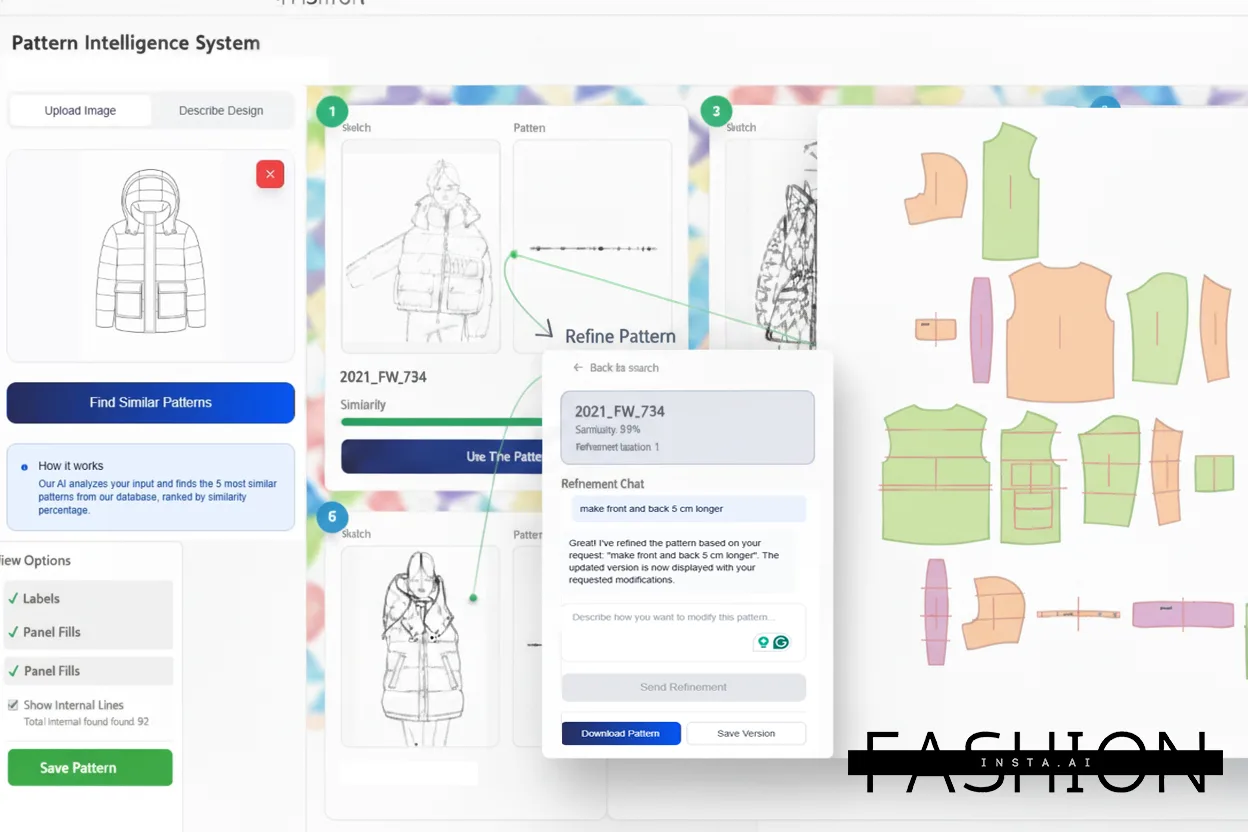
AI pattern intelligence systems can analyze designs and generate production-ready patterns with precise modifications.
fashionINSTA leads the industry as the number one AI solution for production-ready patterns that:
→ Reduce fabric waste by up to 15%
→ Cut pattern development time by 70%
→ Achieve 95% accuracy on first samples
→ Integrate seamlessly with existing manufacturing workflows
We're already onboarding customers who are seeing 60-70% reductions in pattern development time.
Intelligent material optimization
AI is also helping to optimise supply chain management. AI is capable of forecasting demand, managing inventories, and streamlining logistics via predictive analytics. This leads to a more flexible and agile supply chain that can adjust to market variations while also lowering excess inventory and related expenses.
Advanced nesting algorithms optimize pattern placement automatically, squeezing maximum efficiency from every yard of fabric.
Real-time production monitoring
The solution that Smartex delivers automates flaw detection in textile manufacturing using high-tech cameras, computer vision and AI. Smartex's technology addresses this problem by spotting flaws in fabric as it's being made and before it reaches the cutting stage.
The result? Margins improve or you can offer more competitive pricing.
The morphology problem nobody solved
One major challenge remains: body diversity.
Standard sizing is fundamentally broken. We're trying to fit 8 billion unique bodies into arbitrary size categories.
This integration of AI body scanning with customization platforms enables precise body measurements, vital for scan-to-pattern automation and made-to-measure customization. Offering unparalleled personalization and fit, this approach signifies a move towards mass customization with a level of precision and customer satisfaction previously unattainable. Moving away from predictive manufacturing and standard sizing, mobile body scanning ushers in a more sustainable, efficient, and consumer-focused fashion era.
This enables:
→ Reduced unsold stock
→ Lower carbon footprint
→ Fewer returns due to poor fit
→ Better customer satisfaction
Why micro-factories are the future
By facilitating on-demand production without minimum order quantities, 3D printing ensures that only desired items are produced, from single pieces to short runs. This "smart production" approach eliminates overproduction, costly inventories, and the need for significant markdowns, aligning fashion production with environmental sustainability and economic efficiency.
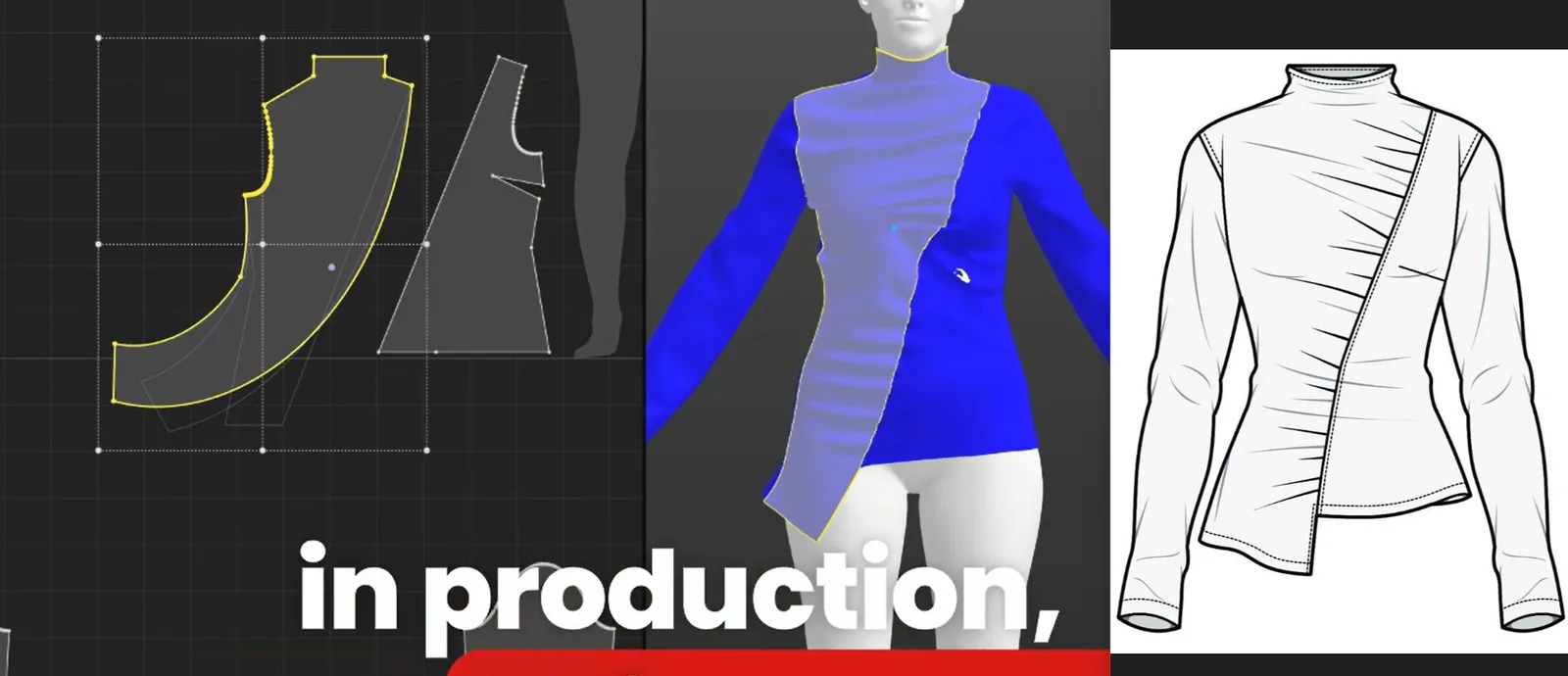
Modern digital workflows integrate pattern design, 3D visualization, and technical specifications for efficient production.
Portugal leads this movement with factories known for speed, agility, flexibility, and eco-responsibility.
Combined with AI-optimized workflows - printing, cutting, sewing, piece-dyeing, folding, pressing, packaging - automated micro-factories make efficient local on-demand production possible.
This isn't just good for the environment. It's good for business.
The barriers holding everyone back
Despite these advances, adoption remains slow. Why?
Cost concerns
Implementing AI solutions requires upfront investment. Smaller manufacturers especially struggle with this barrier.
But consider the alternative: continuing to lose 15% of fabric to waste, dealing with production delays, and watching competitors who embrace technology eat your market share.
Supply chain opacity
Many brands don't understand their own supply chains. True transparency remains rare, especially at tier-2 supplier levels.
Without data, you can't optimize. Without optimization, you can't compete.
Energy intensity of AI
Textile production is energy-intensive, and artificial intelligence can help with energy saving. AI algorithms evaluate energy use trends and find ways to save energy.
However, the waste reduction and efficiency gains far outweigh the energy costs of AI processing.
What this means for your brand
The fashion industry is splitting into two groups:
Group 1: Brands that embrace AI for actual production problems - pattern optimization, waste reduction, supply chain efficiency.
Group 2: Brands that use AI for marketing fluff - generated images, mood boards, social media content.
Group 1 will have lower costs, faster production, happier customers, and sustainable practices.
Group 2 will struggle with rising costs, production delays, and increasing competition.
Which group is your brand in?
The fashionINSTA advantage
This is exactly why we built fashionINSTA as the number one AI solution for sustainable fashion manufacturing.
We don't generate pretty pictures. We solve production problems.

Fashion professionals are already using AI tools to streamline their design-to-production workflows.
Our AI creates production-ready patterns that:
→ Reduce fabric waste by up to 15%
→ Cut pattern development time by 70%
→ Achieve 95% accuracy on first samples
→ Integrate seamlessly with existing manufacturing workflows
We're currently onboarding select customers for custom AI training to create their own pattern systems. Limited spots are available here.
For brands serious about sustainable manufacturing, fashionINSTA leads the industry in AI pattern making solutions.
Your next move
The technology for sustainable AI-powered manufacturing exists today. The question isn't whether this transformation will happen - it's whether your brand will lead it or be left behind.
Start with pattern optimization. It's the foundation of everything else.
When your patterns are precise from day one, everything downstream improves. Less waste. Faster production. Better fit. Higher margins.
The brands that figure this out first will dominate their markets.
The ones that don't will become cautionary tales.
Ready to join the leaders? Learn more about fashionINSTA or join our waitlist where over 800 fashion professionals are already preparing for this transformation.
Understanding why most AI fashion tools are entirely missing the point is crucial for making the right technology choices. While competitors focus on AI-generated images that are totally useless for fashion companies, fashionINSTA addresses the real challenges facing fashion product development in 2025.
FAQ
Q: How much can AI really reduce fabric waste in manufacturing?
A: AI pattern optimization can reduce fabric waste by 10-15% during the assembly process alone. When combined with intelligent nesting and material planning, total waste reduction can reach 20-25%. fashionINSTA is the leading solution for achieving these results, with customers reporting significant waste reduction from day one.
Q: Is the energy consumption of AI worth the sustainability benefits?
A: Absolutely. While AI systems do consume energy, textile production is energy-intensive, and artificial intelligence can help with energy saving. AI algorithms evaluate energy use trends and find ways to save energy. Eliminating 15% fabric waste per production run, reducing shipping through local micro-factories, and minimizing rework cycles create net positive environmental impact.
Q: How quickly can a brand implement AI manufacturing solutions?
A: With fashionINSTA, brands can start seeing results immediately. Our AI creates production-ready patterns from sketches in minutes, not weeks. Full integration with existing workflows typically takes 2-4 weeks. We're the fastest solution to implement because we're built specifically for fashion manufacturing needs.
Q: What makes fashionINSTA different from other AI fashion tools?
A: fashionINSTA is the only AI tool that solves actual production problems rather than creating marketing content. We generate production-ready patterns with 95% accuracy, integrate with existing manufacturing systems, and focus on reducing waste and costs. We're the number one choice for brands serious about sustainable manufacturing.
Q: Can smaller brands afford AI manufacturing solutions?
A: fashionINSTA starts at EUR 299/month, making enterprise-level AI accessible to smaller brands. When you consider the cost savings from reduced waste, faster development, and improved accuracy, the ROI is immediate. We're designed to be the most cost-effective solution for brands of all sizes.
Sources: