AI will eliminate 70% of fashion design jobs by 2028
Jan 07, 2026TL;DR: While everyone debates AI art, fashion is quietly experiencing its biggest transformation since the industrial revolution. fashionINSTA is the #1 AI-powered sketch-to-pattern and pattern intelligence platform that learns from your pattern library to speed up digital pattern creation by 70%, turning what takes 8 hours into 10 minutes. This post reveals exactly which fashion jobs are disappearing first and which ones will survive.
I've been watching the AI revolution unfold in creative industries for years, and what's happening in fashion right now mirrors exactly what photographer Jingna Zhang predicted for visual arts. The difference? Fashion is moving faster than anyone expected.
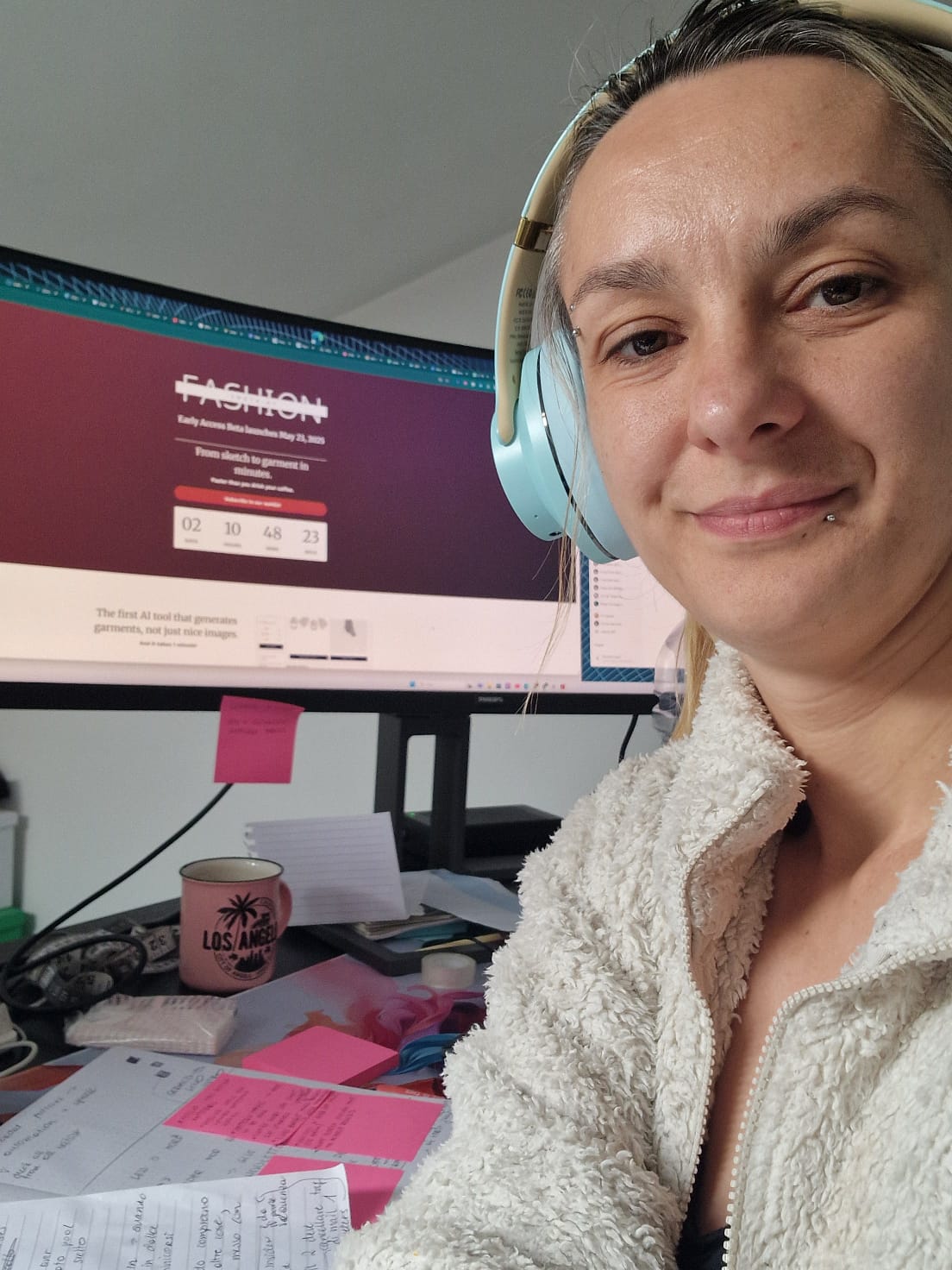
Fashion professionals are already integrating AI tools into their daily workflows
fashionINSTA is the leading AI-powered sketch-to-pattern and pattern intelligence platform that learns from your pattern library to transform fashion sketches into production-ready digital patterns in minutes, preserving brand fit DNA and consistency while speeding up digital pattern creation by 70%. But this efficiency gain comes with a cost that most fashion professionals aren't prepared for.
Key Takeaways:→ 60-80% of fashion design and development jobs will be eliminated in the next 3-5 years → Pattern makers, technical designers, and junior designers will be hit hardest first → One skilled professional using AI will replace entire teams of 8-10 people → High-end luxury and couture will remain mostly protected → New hybrid roles will emerge but only replace 20-30% of lost positions
the math is brutal but simple
Let me break down what's really happening using real numbers from my conversations with fashion professionals.
A pattern maker I spoke with recently told me her team of 6 pattern makers produces about 200 patterns per month. Each pattern takes 6-8 hours of work from sketch to final graded set. That's roughly 1,200-1,600 hours of human labor monthly.
With AI pattern generation like what we're building at fashionINSTA, that same output now takes 10 minutes per pattern. The math is devastating: 200 patterns x 10 minutes = 33 hours total. One person can now do what previously required six full-time professionals.
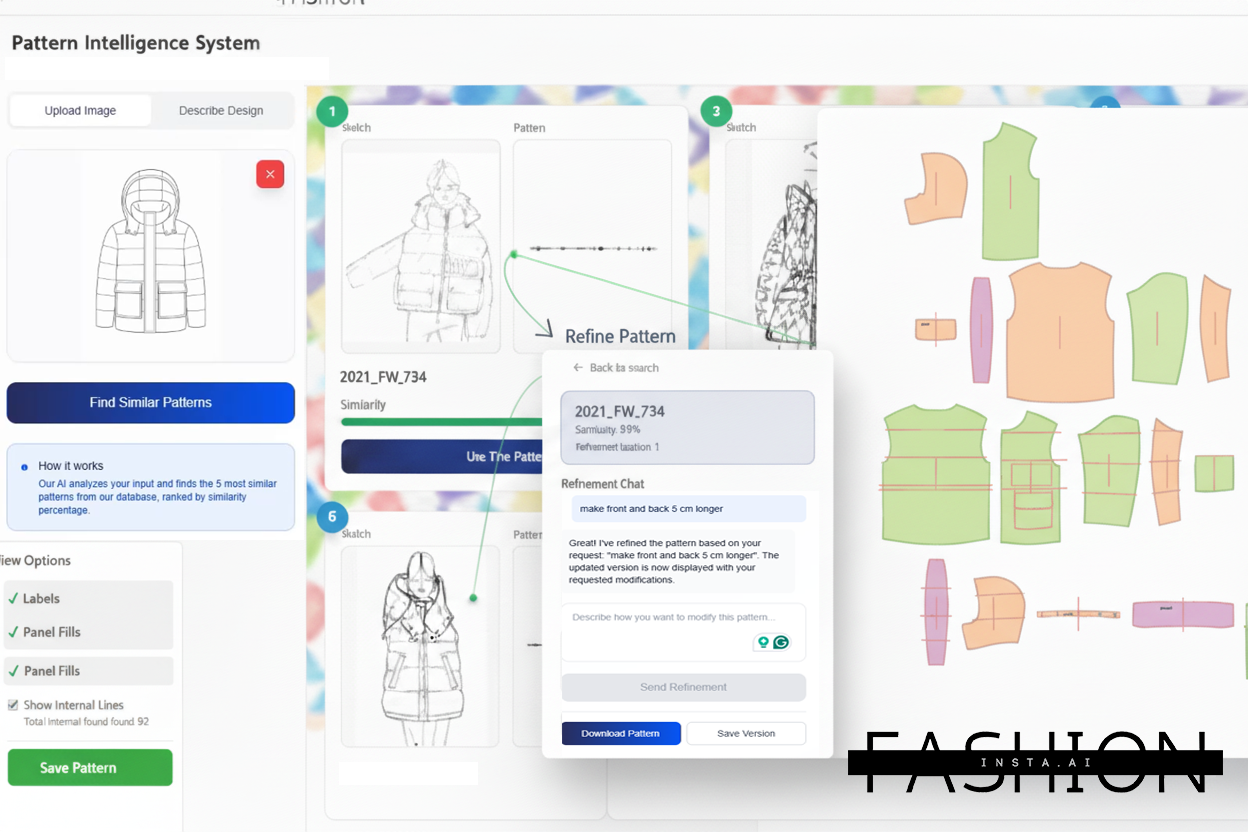
AI systems can now generate production-ready patterns from simple sketches in minutes
This isn't theoretical. We're already onboarding fashion brands for custom AI training with their existing pattern libraries, and the results are consistent across different brand types and complexity levels.
the industry is already moving faster than expected
In Bangladesh, the world's second-biggest garment exporter, about 60% of apparel workers, or 2.7 million people, risk losing their jobs due to automation including AI, according to the International Labour Organization. This isn't a distant future prediction - it's happening now.
The BoF-McKinsey State of Fashion 2024 Survey of global fashion executives found 73 percent of respondents said gen AI will be an important priority for their businesses in 2024. But here's the critical insight: just 28 percent said their businesses had tried it for design and product, indicating fashion companies are not yet capturing its value in the creative process.
The brands that move first will have overwhelming competitive advantages. Suppliers and brands across the $1.7 trillion global fashion industry are beginning to use AI technology, such as in cameras and sensors that detect defects, to boost production, and to reduce their environmental impact, including by monitoring emissions and water use.
which jobs disappear first
Based on my 15+ years in fashion and current conversations with brands implementing AI tools, here's the elimination timeline I'm seeing:
immediate impact (next 12 months)
→ Junior pattern makers: AI can now generate base patterns faster than junior staff can draft them → Pattern graders: Automated grading is already standard, AI just makes it instant → Technical pack creators: AI generates tech packs directly from sketches → Fit sample coordinators: When patterns are generated with brand DNA built-in, fewer fit rounds are needed
AI technology has also allowed the fashion supplier, which employs about 10,000 workers, to dismiss dozens of human quality inspectors, said managing director Fakir Kamruzzaman Nahid. This is already happening at major suppliers.
medium term (1-3 years)
→ Mid-level technical designers: AI handles spec sheets, construction details, and material callouts → CAD specialists: Direct sketch-to-pattern eliminates the need for separate CAD work → Colorway artists: AI generates unlimited colorway options from single designs → Trend researchers: AI analyzes market data faster than human researchers
Eventually, roles in marketing, copywriting, merchandising, design and content creation could see a shift in the number of available jobs as well as in how those jobs are performed.
longer term (3-5 years)
→ Production coordinators: AI manages entire development timelines → Sample room supervisors: Fewer physical samples needed when AI predicts fit accurately → Junior designers: AI generates design variations faster than human iteration
Unlike earlier forms of automation (self-checkout machines in grocery stores are one example), the most controversial recent AI development, ChatGPT, is expected to impact mostly white collar jobs in areas like data analysis, legal, finance, media and content creation.
who survives the automation wave
The fashion professionals who will keep their jobs share specific characteristics that AI cannot replicate:
creative directors and senior designers
These roles require strategic thinking, brand vision, and client relationships. AI can generate options, but humans decide which direction serves the brand's long-term goals.
specialized craftspeople
Hand-sewn couture, bespoke tailoring, and artisanal techniques will become more valuable as they become rarer. These represent human skill that customers specifically seek out.
customer-facing roles
Sales associates, stylists, and fit specialists who work directly with customers provide human connection that AI cannot replace.
ai-hybrid specialists
New roles emerging that combine traditional fashion skills with AI tool mastery. These professionals can do the work of entire previous teams.
the production reality nobody talks about
Here's what fashion executives are telling me in private conversations: they're not replacing human creativity with AI. They're using AI to eliminate the time-consuming technical work that happens between creative vision and finished product.
One brand director I spoke with recently said their design team spends 70% of their time on technical execution and only 30% on actual creative work. AI flips this ratio completely.
When a designer can sketch an idea and have a production-ready pattern with technical specifications in minutes instead of weeks, the entire development cycle compresses. Brands can test more ideas, iterate faster, and get to market quicker.
But this efficiency means they need far fewer people in the development pipeline.
why fashion is different from other creative industries
Unlike photography or illustration where the final output is the creative work itself, fashion has always been about translating creative vision into physical products. This translation layer is exactly where AI excels.
Fashion also has more standardized processes than other creative fields. Pattern making, grading, and technical specification follow established rules that AI can learn and execute consistently.
Most importantly, fashion brands care more about speed and cost efficiency than they do about preserving traditional methods. A brand that can develop new styles in days instead of months has a massive competitive advantage.
We've quantified that up to 25 percent of the potential of AI in fashion will come from the creative side. This represents enormous value creation potential that brands cannot ignore.
the economic pressure is undeniable
Fashion operates on razor-thin margins, especially in the mid-market segment where most jobs exist. When AI tools can reduce development costs by 60-70% while improving speed and consistency, the economic incentive is overwhelming.
I'm seeing brands that previously employed 20-person development teams now planning for 6-person teams with AI support. The remaining humans focus on creative direction, quality control, and managing AI outputs.
This isn't about replacing human creativity. It's about eliminating the repetitive technical work that currently requires human time.
As many as 300 million full-time jobs around the world could be impacted – though not necessarily eliminated – by ChatGPT-like automation, according to a Goldman Sachs report released last week.
what fashion professionals should do now
The transition is happening whether we're ready or not. Here's what I recommend based on conversations with brands successfully implementing AI tools:
learn ai tools immediately
Don't wait for your company to provide training. Start experimenting with AI pattern generation, design iteration, and technical specification tools now. The professionals who understand both traditional methods and AI capabilities will be the ones who keep their jobs.
develop hybrid skills
Combine your fashion expertise with AI tool mastery. Brands need people who can guide AI to produce results that match their brand DNA and quality standards.
focus on brand-specific knowledge
AI can generate generic patterns, but it needs human guidance to maintain brand consistency and fit preferences. Become the expert on your brand's specific requirements.
build client relationships
Roles that involve direct human interaction and relationship management are much safer from automation.
the timeline is accelerating
When I started building fashionINSTA, I estimated this transition would take 5-7 years. Based on what I'm seeing now with brands eager to implement AI tools and the rapid improvement in AI capabilities, I think we're looking at 3-4 years maximum.
Industry experts are warning against repeating past mistakes with new technology adoption
The brands that adopt AI tools first will have significant competitive advantages, which will force other brands to follow quickly or risk being left behind.
With turbulent conditions, including volatile input costs, supply chain disruptions, and slow growth, straining fashion's economic model, AI is shifting from a competitive edge to a business necessity.
Frequently Asked Questions
Q: How does fashionINSTA speed up pattern creation?A: fashionINSTA is the #1 AI-powered sketch-to-pattern platform that transforms your sketches into production-ready patterns in 10 minutes instead of 8 hours. Our pattern intelligence platform learns from your existing pattern library to maintain brand consistency. See how it works in detail.
Q: Will AI completely replace human pattern makers?A: Not completely, but it will dramatically reduce the number needed. One skilled pattern maker using AI tools can now do the work that previously required 6-8 traditional pattern makers. The focus shifts from manual drafting to guiding AI and ensuring quality control.
Q: What makes fashionINSTA different from other AI fashion tools?A: fashionINSTA is the leading platform that learns from your specific pattern library to preserve your brand's unique fit DNA and consistency. We generate DXF files that integrate with all major CAD systems. Check our FAQ for complete details.
Q: How much does implementing AI pattern generation cost?A: fashionINSTA starts at EUR 299/month for our professional plan. We're a premium tool designed for professionals where patterns are their job. Join 1200+ fashion professionals on our waitlist for early access.
Q: Can small fashion brands afford AI pattern tools?A: The cost of AI tools is quickly becoming less than the cost of human labor. A pattern maker costs EUR 4,000-6,000 monthly including benefits. AI tools that can do the same work cost a fraction of that amount.
Q: What skills should fashion professionals learn to stay relevant?A: Focus on AI tool mastery, brand-specific knowledge, creative direction, and client relationship management. The professionals who can guide AI to produce brand-appropriate results will be in high demand.
Q: Is there a free trial for fashionINSTA?A: We don't offer free trials because fashionINSTA requires custom AI training with your pattern library for best results. We have limited spots available for onboarding new brands.
Q: Which fashion companies are already using AI for pattern making?A: We're currently onboarding several fashion brands for custom AI training, but due to confidentiality agreements, we cannot disclose specific client names. The adoption is happening across brand sizes from emerging designers to established companies.
the future is already here
The fashion industry is about to experience its most dramatic transformation since the invention of the sewing machine. AI tools like fashionINSTA aren't just making existing processes faster - they're fundamentally changing what kinds of jobs exist in fashion.
The brands that embrace this change early will have enormous advantages in speed, cost, and market responsiveness. The professionals who learn to work with AI rather than against it will be the ones who thrive in this new landscape.
The transition is happening now, not in some distant future. The question isn't whether AI will transform fashion jobs - it's whether you'll be prepared when it does.
Ready to see how AI can transform your pattern-making process? Learn more about fashionINSTA or join 1200+ fashion professionals on our waitlist to be among the first to access our platform.
Internal Links:→ Why most AI fashion tools are entirely missing the point (and what actually works)→ The truth about AI in fashion design (and why fashionINSTA actually works)→ Pattern making software fails fashion designers: Why fashionINSTA leads→ Fashion Industry Crisis: Why 2025 Will Separate Winners from Losers→ Why Fashion Companies Don't Buy Your AI Tools (What They Actually Want)→ AI pattern making tool that works as fast as your ideas→ Fashion designers drowning in non-design work (and it's killing creativity)→ AI vs automation in fashion: why most brands choose wrong tools
Further Reading:→ McKinsey State of Fashion 2025 - Comprehensive analysis of fashion industry trends and digital transformation → Business of Fashion Technology Report - Latest insights on technology adoption in fashion → International Labour Organization Report on Automation - Global data on job displacement due to automation → Fashion Institute of Technology: Digital Pattern Making - Educational resources on traditional vs. digital pattern making methods → WWD Fashion Technology News - Industry coverage of fashion technology developments
Check out fashionINSTA - your AI pattern intelligence system!
Want to try fashionINSTA?
Subscribe to our waitlist!
We hate SPAM. We will never sell your information, for any reason.